The Drop · September 7, 2026
Afrobeats and amapiano visualizer: a groove that is not four on the floor
Every beat reactive tool is built on one assumption: the kick is the loudest thing and the loudest thing is the beat. Load an amapiano track and that assumption falls apart in the first eight bars.
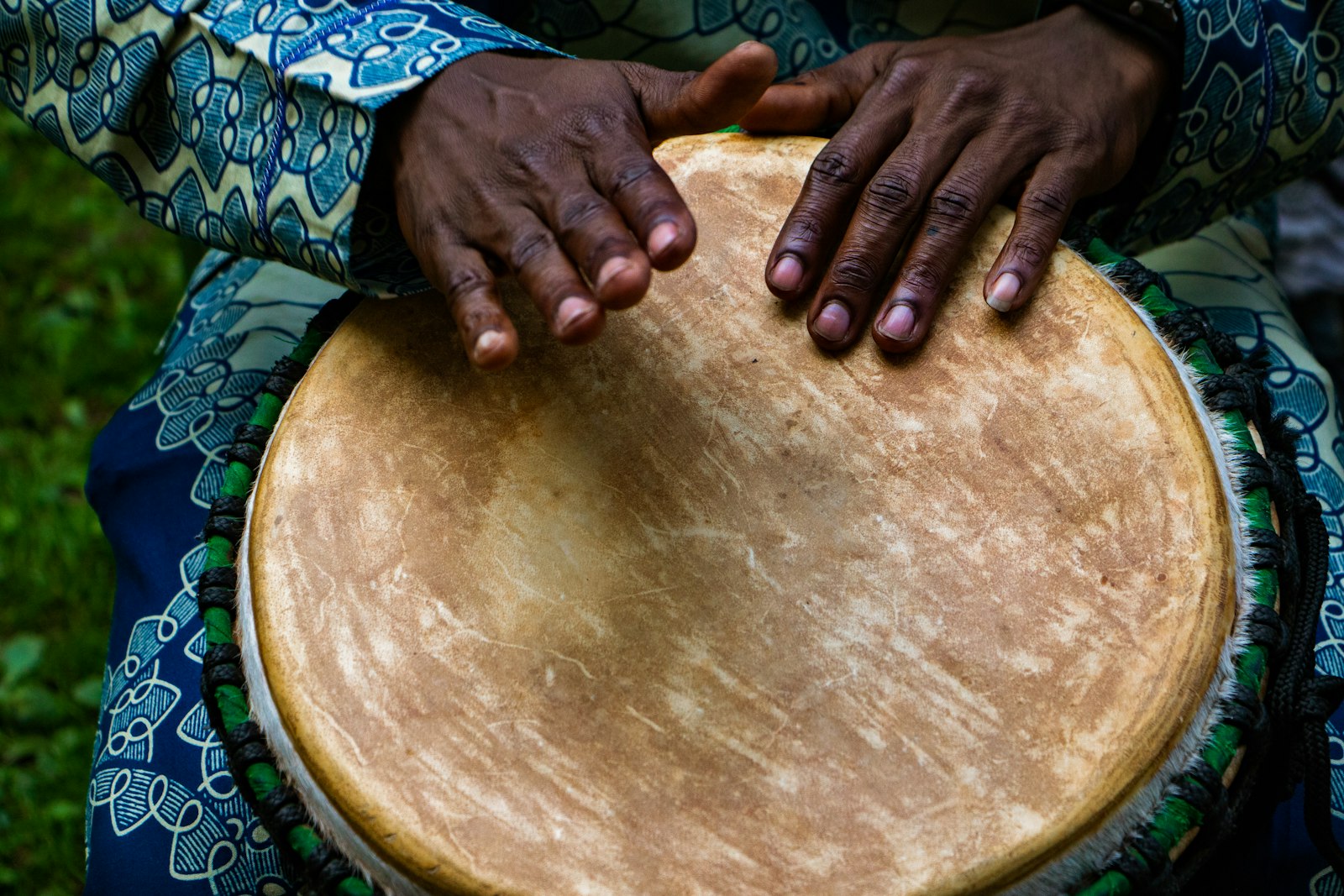
Photo via Unsplash
What is actually carrying the beat
In house or techno the kick is both the loudest event and the metronome, so anything that watches low frequency energy gets the grid for free. That is why the house post can spend its time on how fast to change what is on screen rather than on whether the tool finds the pulse at all.
Afrobeats and amapiano spread the job around. Timekeeping lives in the shakers, the rimshots and the hand percussion. The bass is a melodic voice with its own phrasing rather than a thud under the kick, and in a lot of amapiano the kick is doing less work than the log drum sitting on top of it. If you point a visualizer at this and it feels late or randomly timed, nothing is broken. It is following the loudest low end, and here the loudest low end is not the beat.
The log drum sustains, so a flux detector barely sees it
The per drum triggers in this app do not look at how loud a band is. They look at how much it rose since the previous frame, which is why a bassline that holds a steady level does not keep firing them. That works beautifully on a snare, which is a sharp rise and then gone.
An amapiano log drum is the opposite shape. Short attack, then a long pitched sustain that is still the biggest thing in the mix while it decays. It announces itself once, in a single frame, and then contributes nothing for the rest of the note. Sliding bass moves are worse again, because a pitch change with no new attack produces no rise at all. Wait for the visuals to punch on every log drum note and you will be waiting.
There is a second effect worth knowing. The main flash detector sums energy across bins 1 to 27, roughly 40 Hz up to 2.3 kHz, and compares it against a rolling average. A log drum that is present almost continuously raises that average, so the bar every other sound has to clear goes up. Flashes get rarer, not denser, exactly when the track feels busiest.
Move your image triggers up: snare and hi-hat
Each image you upload gets a role, and the bands behind those roles are fixed:
- Kick listens from about 86 Hz to 600 Hz.
- Snare covers roughly 775 Hz to 3 kHz, which is where rimshots, claps and the crack of a snare live.
- Hi-hat runs from about 6 kHz to 15.5 kHz, which is shakers, closed hats, tambourine and most of the top end texture.
For these genres, put the artwork you actually want seen on Snare and the supporting images on Hi-hat. The percussion pattern is the groove, so triggering on it is triggering on the thing people are moving to. This is the same mechanism the trap post uses for hat rolls, pointed at a completely different musical job.
The kick role is not useless, just ambiguous here. A log drum lives in the same 86 to 600 Hz window as the kick, so an image on Kick will fire on log drum attacks as well as kicks. Sometimes that is precisely what you want. Just do not assume you are seeing the kick pattern.
Turn the bass drop detector down, or off
The drop detector ships at zero, and on a log drum track that default is doing you a favour. It engages two ways: when bass energy jumps against its recent baseline, or when bass energy is sitting near the loudest this track has been. The second path exists so genres with constant heavy bass can still trip it, which is a good idea in dubstep and a trap in amapiano, because once the log drum enters it stays near the track's own peak for the rest of the section.
Push the sensitivity up and you get drop mode locked on for two minutes: continuous glitch slicing, permanent shake, text scrambled the whole way through. It stops meaning anything the moment it stops stopping. Keep it around a quarter of the slider, or at zero, and let the percussion triggers do the work. Same warning for images set to the Bass drop role, which take over the screen while sustained bass is active. On a log drum track, that is most of it.
Tempo is the one easy part
Plenty of genres confuse a tempo scan. These two do not. Mixgraph's tempo index, measured on 7 September 2026, puts the amapiano median at 113 BPM across 5,979 tracks and the afrobeats median at 110 across a much smaller and much wider spread, with the middle half of afrobeats tracks landing between 99 and 116. Both sit comfortably inside the 60 to 180 BPM range the offline scan searches, and comfortably above the point where the app doubles a suspiciously slow reading, so the number you get on load is usually just correct. How beat detection works covers that scan in detail.
Slow the content change rate down
Content changes ride the detected tempo grid, and the default is a change every quarter beat. On a swung, syncopated groove that is a mistake. Four changes per beat is faster than the pattern you are trying to show, so the eye never gets to lock onto anything and the whole thing flattens into a strobe with pictures in it.
Set it to every beat or every 2 beats and let the image triggers add the syncopation on top. That combination is the one that reads as a groove: a steady phrase underneath, percussion hits punching through it off the grid.
A starting point
- Content change rate: every beat, or every 2 beats for something more patient.
- Cover art and the main images on the Snare role. Texture and secondary images on Hi-hat.
- Bass drop detector at zero to start. Raise it slightly only if the track has a genuinely quiet passage for it to measure against.
- Beat sensitivity a little lower than default, since the continuous bass has already lifted the average that flashes are measured against.
- Flash duration longer rather than shorter, to match the patience of the groove.
One note on the flashing
Even at calmer settings this is a strobe tool. Flash rates above three per second can trigger seizures in people with photosensitive epilepsy, so add a warning wherever you post it. The strobe guide has the thresholds written out and the settings for the gentle end of what the app does.
The short version
- The kick is not the event in afrobeats or amapiano. The percussion is.
- A log drum sustains, and the trigger detection reacts to rises, so it fires once per note at most and does nothing during the sustain.
- Put images on the Snare and Hi-hat roles rather than Kick.
- Keep the bass drop detector near zero, or it will stay engaged through the whole log drum section and stop meaning anything.
- Slow the content change rate to every beat or every 2 beats so the swing survives.
- Tempo detection is reliable here, which is not true of every genre.
Try it on your own track
Free, in the browser, no signup and no watermark. Your audio never leaves your machine, and the render comes out as a 1080p WebM you can convert to MP4 with one ffmpeg command. Start from the home page if you want the tour first.
Open the visualizer